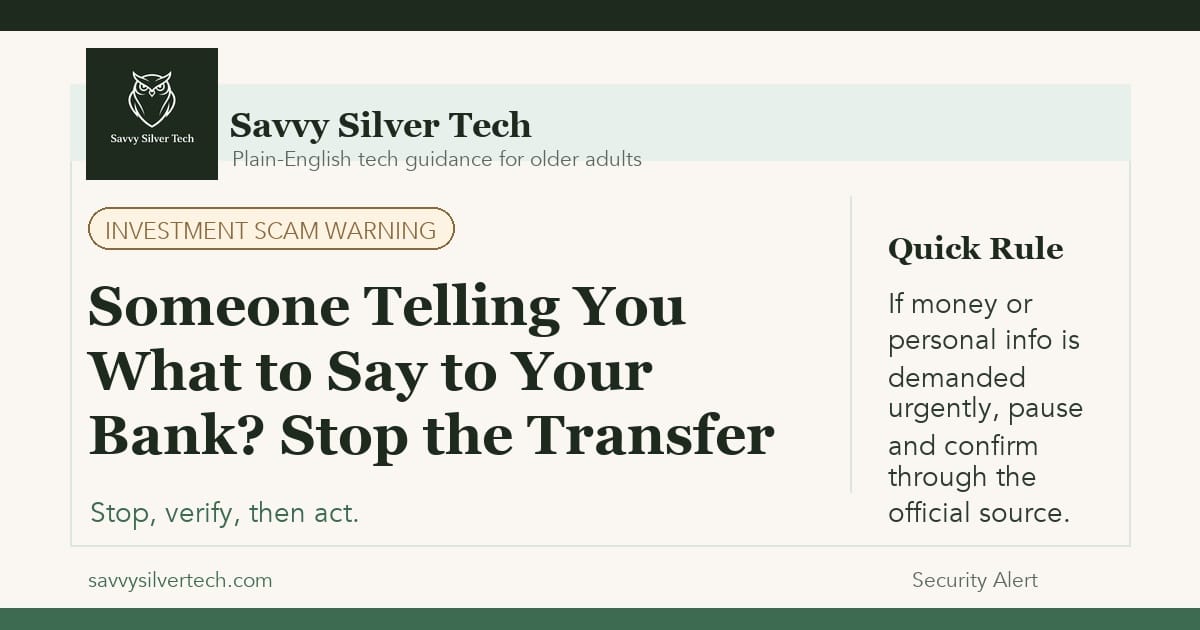
Someone Telling You What to Say to Your Bank? Stop the Transfer
A caller who coaches your answers to a bank or broker may be steering you around fraud safeguards. Stop and speak privately with your financial institution.
All articles in
A caller who coaches your answers to a bank or broker may be steering you around fraud safeguards. Stop and speak privately with your financial institution.
Fake officials use threats, spoofed numbers, convincing documents, and even AI video. Learn the PAUSE signs and how to verify safely.
Unexpected medical equipment on your Medicare statement may be fraud. Here is how to review the charge and report it safely.
Scammers posing as bank or government employees may tell you to move your savings to keep it safe. Hang up and call your bank directly using a trusted number.
Scammers are impersonating law enforcement and claiming that someone missed court or jury duty. Learn the warning signs and how to stay safe.
The FTC warns that paid search ads can look like a company's official payment page while sending you to an unrelated service that may charge surprise fees. Use a trusted bill, statement, bookmark, or typed web address instead.
A July 22 Justice Department case is a fresh reminder of an old scam: criminals call older adults claiming they won a lottery, then demand taxes or fees before the prize can be released. Real prizes do not work that way.
The FBI says scammers are pretending to be the IC3 and FBI personnel to trick past victims into losing even more money. Some are using AI-made videos and fake websites that look official.
The FTC says the fastest way to spot many scams is to notice how someone demands payment. If they push gift cards, wire transfers, cryptocurrency, payment apps, or bank transfers, stop right there.
The IRS said on July 16 that taxpayers can request a free Identity Protection PIN to help stop someone else from filing a federal tax return in their name. It is a simple extra step that can matter long before next spring.
A new South Carolina consumer warning says more than 1.1 million residents were affected by reported security breaches in the first half of 2026. The message is broader than one state: if a breach notice shows up in your mailbox or inbox, move quickly instead of setting it aside.
VA says scammers are mailing fake "Veterans Savings Program" postcards that promise extra benefits or payments, then pushing people to call and hand over private information. If you or your spouse receives one, treat it like a phishing attack on paper.